Jane Eyre by Charlotte Brontë دانلود فیلم و خلاصه رمان انگلیسی
Jane Eyre
Charlotte Brontë
Charlotte Brontë was born in Yorkshire, England on April 21, 1816 to Maria Branwell and Patrick Brontë. Because Charlotte’s mother died when Charlotte was five years old, Charlotte’s aunt, a devout Methodist, helped her brother-in-law raise his children. In 1824 Charlotte and three of her sisters—Maria, Elizabeth, and Emily—were sent to Cowan Bridge, a school for clergymen’s daughters. When an outbreak of tuberculosis killed Maria and Elizabeth, Charlotte and Emily were brought home. Several years later, Charlotte returned to school, this time in Roe Head, England. She became a teacher at the school in 1835 but decided after several years to become a private governess instead. She was hired to live with and tutor the children of the wealthy Sidgewick family in 1839, but the job was a misery to her and she soon left it. Once Charlotte recognized that her dream of starting her own school was not immediately realizable, however, she returned to working as a governess, this time for a different family. Finding herself equally disappointed with governess work the second time around, Charlotte recruited her sisters to join her in more serious preparation for the establishment of a school.
Although the Brontës’ school was unsuccessful, their literary projects flourished. At a young age, the children created a fictional world they named Angria, and their many stories, poems, and plays were early predictors of shared writing talent that eventually led Emily, Anne, and Charlotte to careers as novelists. As adults, Charlotte suggested that she, Anne, and Emily collaborate on a book of poems. The three sisters published under male pseudonyms: Charlotte’s was Currer Bell, while Emily and Anne wrote as Ellis and Acton Bell, respectively. When the poetry volume received little public notice, the sisters decided to work on separate novels but retained the same pseudonyms. Anne and Emily produced their masterpieces in 1847, but Charlotte’s first book, The Professor, never found a willing publisher during her lifetime. Charlotte wrote Jane Eyre later that year. The book, a critique of Victorian assumptions about gender and social class, became one of the most successful novels of its era, both critically and commercially.
Autobiographical elements are recognizable throughout Jane Eyre. Jane’s experience at Lowood School, where her dearest friend dies of tuberculosis, recalls the death of Charlotte’s sisters at Cowan Bridge. The hypocritical religious fervor of the headmaster, Mr. Brocklehurst, is based in part on that of the Reverend Carus Wilson, the Evangelical minister who ran Cowan Bridge. Charlotte took revenge upon the school that treated her so poorly by using it as the basis for the fictional Lowood. Jane’s friend Helen Burns’s tragic death from tuberculosis recalls the deaths of two of Charlotte’s sisters, Maria and Elizabeth, who succumbed to the same disease during their time at Cowan Bridge. Additionally, John Reed’s decline into alcoholism and dissolution is most likely modeled upon the life of Charlotte Brontë’s brother Branwell, who slid into opium and alcohol addictions in the years preceding his death. Finally, like Charlotte, Jane becomes a governess—a neutral vantage point from which to observe and describe the oppressive social ideas and practices of nineteenth-century Victorian society.
The plot of Jane Eyre follows the form of a Bildungsroman, which is a novel that tells the story of a child’s maturation and focuses on the emotions and experiences that accompany and incite his or her growth to adulthood. In Jane Eyre, there are five distinct stages of development, each linked to a particular place: Jane’s childhood at Gateshead, her education at the Lowood School, her time as Adèle’s governess at Thornfield, her time with the Rivers family at Morton and at Marsh End (also called Moor House), and her reunion with and marriage to Rochester at Ferndean. From these experiences, Jane becomes the mature woman who narrates the novel retrospectively.
But the Bildungsroman plot of Jane Eyre, and the book’s element of social criticism, are filtered through a third literary tradition—that of the Gothic horror story. Like the Bildungsroman, the Gothic genre originated in Germany. It became popular in England in the late eighteenth century, and it generally describes supernatural experiences, remote landscapes, and mysterious occurrences, all of which are intended to create an atmosphere of suspense and fear. Jane’s encounters with ghosts, dark secrets, and sinister plots add a potent and lingering sense of fantasy and mystery to the novel.
After the success of Jane Eyre, Charlotte revealed her identity to her publisher and went on to write several other novels, most notably Shirley in 1849. In the years that followed, she became a respected member of London’s literary set. But the deaths of siblings Emily and Branwell in 1848, and of Anne in 1849, left her feeling dejected and emotionally isolated. In 1854, she wed the Reverend Arthur Nicholls, despite the fact that she did not love him. She died of pneumonia, while pregnant, the following year.
Plot Overview
Jane Eyre is a young orphan being raised by Mrs. Reed, her cruel, wealthy aunt. A servant named Bessie provides Jane with some of the few kindnesses she receives, telling her stories and singing songs to her. One day, as punishment for fighting with her bullying cousin John Reed, Jane’s aunt imprisons Jane in the red-room, the room in which Jane’s Uncle Reed died. While locked in, Jane, believing that she sees her uncle’s ghost, screams and faints. She wakes to find herself in the care of Bessie and the kindly apothecary Mr. Lloyd, who suggests to Mrs. Reed that Jane be sent away to school. To Jane’s delight, Mrs. Reed concurs.
Once at the Lowood School, Jane finds that her life is far from idyllic. The school’s headmaster is Mr. Brocklehurst, a cruel, hypocritical, and abusive man. Brocklehurst preaches a doctrine of poverty and privation to his students while using the school’s funds to provide a wealthy and opulent lifestyle for his own family. At Lowood, Jane befriends a young girl named Helen Burns, whose strong, martyrlike attitude toward the school’s miseries is both helpful and displeasing to Jane. A massive typhus epidemic sweeps Lowood, and Helen dies of consumption. The epidemic also results in the departure of Mr. Brocklehurst by attracting attention to the insalubrious conditions at Lowood. After a group of more sympathetic gentlemen takes Brocklehurst’s place, Jane’s life improves dramatically. She spends eight more years at Lowood, six as a student and two as a teacher.
After teaching for two years, Jane yearns for new experiences. She accepts a governess position at a manor called Thornfield, where she teaches a lively French girl named Adèle. The distinguished housekeeper Mrs. Fairfax presides over the estate. Jane’s employer at Thornfield is a dark, impassioned man named Rochester, with whom Jane finds herself falling secretly in love. She saves Rochester from a fire one night, which he claims was started by a drunken servant named Grace Poole. But because Grace Poole continues to work at Thornfield, Jane concludes that she has not been told the entire story. Jane sinks into despondency when Rochester brings home a beautiful but vicious woman named Blanche Ingram. Jane expects Rochester to propose to Blanche. But Rochester instead proposes to Jane, who accepts almost disbelievingly.
The wedding day arrives, and as Jane and Mr. Rochester prepare to exchange their vows, the voice of Mr. Mason cries out that Rochester already has a wife. Mason introduces himself as the brother of that wife—a woman named Bertha. Mr. Mason testifies that Bertha, whom Rochester married when he was a young man in Jamaica, is still alive. Rochester does not deny Mason’s claims, but he explains that Bertha has gone mad. He takes the wedding party back to Thornfield, where they witness the insane Bertha Mason scurrying around on all fours and growling like an animal. Rochester keeps Bertha hidden on the third story of Thornfield and pays Grace Poole to keep his wife under control. Bertha was the real cause of the mysterious fire earlier in the story. Knowing that it is impossible for her to be with Rochester, Jane flees Thornfield.
Penniless and hungry, Jane is forced to sleep outdoors and beg for food. At last, three siblings who live in a manor alternatively called Marsh End and Moor House take her in. Their names are Mary, Diana, and St. John (pronounced “Sinjin”) Rivers, and Jane quickly becomes friends with them. St. John is a clergyman, and he finds Jane a job teaching at a charity school in Morton. He surprises her one day by declaring that her uncle, John Eyre, has died and left her a large fortune: 20,000 pounds. When Jane asks how he received this news, he shocks her further by declaring that her uncle was also his uncle: Jane and the Riverses are cousins. Jane immediately decides to share her inheritance equally with her three newfound relatives.
St. John decides to travel to India as a missionary, and he urges Jane to accompany him—as his wife. Jane agrees to go to India but refuses to marry her cousin because she does not love him. St. John pressures her to reconsider, and she nearly gives in. However, she realizes that she cannot abandon forever the man she truly loves when one night she hears Rochester’s voice calling her name over the moors. Jane immediately hurries back to Thornfield and finds that it has been burned to the ground by Bertha Mason, who lost her life in the fire. Rochester saved the servants but lost his eyesight and one of his hands. Jane travels on to Rochester’s new residence, Ferndean, where he lives with two servants named John and Mary.
At Ferndean, Rochester and Jane rebuild their relationship and soon marry. At the end of her story, Jane writes that she has been married for ten blissful years and that she and Rochester enjoy perfect equality in their life together. She says that after two years of blindness, Rochester regained sight in one eye and was able to behold their first son at his birth.
Analysis of Major Characters
Jane Eyre
The development of Jane Eyre’s character is central to the novel. From the beginning, Jane possesses a sense of her self-worth and dignity, a commitment to justice and principle, a trust in God, and a passionate disposition. Her integrity is continually tested over the course of the novel, and Jane must learn to balance the frequently conflicting aspects of herself so as to find contentment.
The development of Jane Eyre’s character is central to the novel. From the beginning, Jane possesses a sense of her self-worth and dignity, a commitment to justice and principle, a trust in God, and a passionate disposition. Her integrity is continually tested over the course of the novel, and Jane must learn to balance the frequently conflicting aspects of herself so as to find contentment.
An orphan since early childhood, Jane feels exiled and ostracized at the beginning of the novel, and the cruel treatment she receives from her Aunt Reed and her cousins only exacerbates her feeling of alienation. Afraid that she will never find a true sense of home or community, Jane feels the need to belong somewhere, to find “kin,” or at least “kindred spirits.” This desire tempers her equally intense need for autonomy and freedom.
In her search for freedom, Jane also struggles with the question of what type of freedom she wants. While Rochester initially offers Jane a chance to liberate her passions, Jane comes to realize that such freedom could also mean enslavement—by living as Rochester’s mistress, she would be sacrificing her dignity and integrity for the sake of her feelings. St. John Rivers offers Jane another kind of freedom: the freedom to act unreservedly on her principles. He opens to Jane the possibility of exercising her talents fully by working and living with him in India. Jane eventually realizes, though, that this freedom would also constitute a form of imprisonment, because she would be forced to keep her true feelings and her true passions always in check.
Charlotte Brontë may have created the character of Jane Eyre as a means of coming to terms with elements of her own life. Much evidence suggests that Brontë, too, struggled to find a balance between love and freedom and to find others who understood her. At many points in the book, Jane voices the author’s then-radical opinions on religion, social class, and gender.
Edward Rochester
Despite his stern manner and not particularly handsome appearance, Edward Rochester wins Jane’s heart, because she feels they are kindred spirits, and because he is the first person in the novel to offer Jane lasting love and a real home. Although Rochester is Jane’s social and economic superior, and although men were widely considered to be naturally superior to women in the Victorian period, Jane is Rochester’s intellectual equal. Moreover, after their marriage is interrupted by the disclosure that Rochester is already married to Bertha Mason, Jane is proven to be Rochester’s moral superior.
Rochester regrets his former libertinism and lustfulness; nevertheless, he has proven himself to be weaker in many ways than Jane. Jane feels that living with Rochester as his mistress would mean the loss of her dignity. Ultimately, she would become degraded and dependent upon Rochester for love, while unprotected by any true marriage bond. Jane will only enter into marriage with Rochester after she has gained a fortune and a family, and after she has been on the verge of abandoning passion altogether. She waits until she is not unduly influenced by her own poverty, loneliness, psychological vulnerability, or passion. Additionally, because Rochester has been blinded by the fire and has lost his manor house at the end of the novel, he has become weaker while Jane has grown in strength—Jane claims that they are equals, but the marriage dynamic has actually tipped in her favor.
St. John Rivers
St. John Rivers is a foil to Edward Rochester. Whereas Rochester is passionate, St. John is austere and ambitious. Jane often describes Rochester’s eyes as flashing and flaming, whereas she constantly associates St. John with rock, ice, and snow. Marriage with Rochester represents the abandonment of principle for the consummation of passion, but marriage to St. John would mean sacrificing passion for principle. When he invites her to come to India with him as a missionary, St. John offers Jane the chance to make a more meaningful contribution to society than she would as a housewife. At the same time, life with St. John would mean life without true love, in which Jane’s need for spiritual solace would be filled only by retreat into the recesses of her own soul. Independence would be accompanied by loneliness, and joining St. John would require Jane to neglect her own legitimate needs for love and emotional support. Her consideration of St. John’s proposal leads Jane to understand that, paradoxically, a large part of one’s personal freedom is found in a relationship of mutual emotional dependence.
Helen Burns
Helen Burns, Jane’s friend at Lowood School, serves as a foil to Mr. Brocklehurst as well as to Jane. While Mr. Brocklehurst embodies an evangelical form of religion that seeks to strip others of their excessive pride or of their ability to take pleasure in worldly things, Helen represents a mode of Christianity that stresses tolerance and acceptance. Brocklehurst uses religion to gain power and to control others; Helen ascetically trusts her own faith and turns the other cheek to Lowood’s harsh policies.
Although Helen manifests a certain strength and intellectual maturity, her efforts involve self-negation rather than self-assertion, and Helen’s submissive and ascetic nature highlights Jane’s more headstrong character. Like Jane, Helen is an orphan who longs for a home, but Helen believes that she will find this home in Heaven rather than Northern England. And while Helen is not oblivious to the injustices the girls suffer at Lowood, she believes that justice will be found in God’s ultimate judgment—God will reward the good and punish the evil. Jane, on the other hand, is unable to have such blind faith. Her quest is for love and happiness in this world. Nevertheless, she counts on God for support and guidance in her search.
An orphan since early childhood, Jane feels exiled and ostracized at the beginning of the novel, and the cruel treatment she receives from her Aunt Reed and her cousins only exacerbates her feeling of alienation. Afraid that she will never find a true sense of home or community, Jane feels the need to belong somewhere, to find “kin,” or at least “kindred spirits.” This desire tempers her equally intense need for autonomy and freedom.
In her search for freedom, Jane also struggles with the question of what type of freedom she wants. While Rochester initially offers Jane a chance to liberate her passions, Jane comes to realize that such freedom could also mean enslavement—by living as Rochester’s mistress, she would be sacrificing her dignity and integrity for the sake of her feelings. St. John Rivers offers Jane another kind of freedom: the freedom to act unreservedly on her principles. He opens to Jane the possibility of exercising her talents fully by working and living with him in India. Jane eventually realizes, though, that this freedom would also constitute a form of imprisonment, because she would be forced to keep her true feelings and her true passions always in check.
Charlotte Brontë may have created the character of Jane Eyre as a means of coming to terms with elements of her own life. Much evidence suggests that Brontë, too, struggled to find a balance between love and freedom and to find others who understood her. At many points in the book, Jane voices the author’s then-radical opinions on religion, social class, and gender.
Edward Rochester
Despite his stern manner and not particularly handsome appearance, Edward Rochester wins Jane’s heart, because she feels they are kindred spirits, and because he is the first person in the novel to offer Jane lasting love and a real home. Although Rochester is Jane’s social and economic superior, and although men were widely considered to be naturally superior to women in the Victorian period, Jane is Rochester’s intellectual equal. Moreover, after their marriage is interrupted by the disclosure that Rochester is already married to Bertha Mason, Jane is proven to be Rochester’s moral superior.
Rochester regrets his former libertinism and lustfulness; nevertheless, he has proven himself to be weaker in many ways than Jane. Jane feels that living with Rochester as his mistress would mean the loss of her dignity. Ultimately, she would become degraded and dependent upon Rochester for love, while unprotected by any true marriage bond. Jane will only enter into marriage with Rochester after she has gained a fortune and a family, and after she has been on the verge of abandoning passion altogether. She waits until she is not unduly influenced by her own poverty, loneliness, psychological vulnerability, or passion. Additionally, because Rochester has been blinded by the fire and has lost his manor house at the end of the novel, he has become weaker while Jane has grown in strength—Jane claims that they are equals, but the marriage dynamic has actually tipped in her favor.
St. John Rivers
St. John Rivers is a foil to Edward Rochester. Whereas Rochester is passionate, St. John is austere and ambitious. Jane often describes Rochester’s eyes as flashing and flaming, whereas she constantly associates St. John with rock, ice, and snow. Marriage with Rochester represents the abandonment of principle for the consummation of passion, but marriage to St. John would mean sacrificing passion for principle. When he invites her to come to India with him as a missionary, St. John offers Jane the chance to make a more meaningful contribution to society than she would as a housewife. At the same time, life with St. John would mean life without true love, in which Jane’s need for spiritual solace would be filled only by retreat into the recesses of her own soul. Independence would be accompanied by loneliness, and joining St. John would require Jane to neglect her own legitimate needs for love and emotional support. Her consideration of St. John’s proposal leads Jane to understand that, paradoxically, a large part of one’s personal freedom is found in a relationship of mutual emotional dependence.
Helen Burns
Helen Burns, Jane’s friend at Lowood School, serves as a foil to Mr. Brocklehurst as well as to Jane. While Mr. Brocklehurst embodies an evangelical form of religion that seeks to strip others of their excessive pride or of their ability to take pleasure in worldly things, Helen represents a mode of Christianity that stresses tolerance and acceptance. Brocklehurst uses religion to gain power and to control others; Helen ascetically trusts her own faith and turns the other cheek to Lowood’s harsh policies.
Although Helen manifests a certain strength and intellectual maturity, her efforts involve self-negation rather than self-assertion, and Helen’s submissive and ascetic nature highlights Jane’s more headstrong character. Like Jane, Helen is an orphan who longs for a home, but Helen believes that she will find this home in Heaven rather than Northern England. And while Helen is not oblivious to the injustices the girls suffer at Lowood, she believes that justice will be found in God’s ultimate judgment—God will reward the good and punish the evil. Jane, on the other hand, is unable to have such blind faith. Her quest is for love and happiness in this world. Nevertheless, she counts on God for support and guidance in her search.
Themes, Motifs & Symbols
Love Versus Autonomy
Jane Eyre is very much the story of a quest to be loved. Jane searches, not just for romantic love, but also for a sense of being valued, of belonging. Thus Jane says to Helen Burns: “to gain some real affection from you, or Miss Temple, or any other whom I truly love, I would willingly submit to have the bone of my arm broken, or to let a bull toss me, or to stand behind a kicking horse, and let it dash its hoof at my chest” (Chapter 8). Yet, over the course of the book, Jane must learn how to gain love without sacrificing and harming herself in the process.
Her fear of losing her autonomy motivates her refusal of Rochester’s marriage proposal. Jane believes that “marrying” Rochester while he remains legally tied to Bertha would mean rendering herself a mistress and sacrificing her own integrity for the sake of emotional gratification. On the other hand, her life at Moor House tests her in the opposite manner. There, she enjoys economic independence and engages in worthwhile and useful work, teaching the poor; yet she lacks emotional sustenance. Although St. John proposes marriage, offering her a partnership built around a common purpose, Jane knows their marriage would remain loveless.
Nonetheless, the events of Jane’s stay at Moor House are necessary tests of Jane’s autonomy. Only after proving her self-sufficiency to herself can she marry Rochester and not be asymmetrically dependent upon him as her “master.” The marriage can be one between equals. As Jane says: “I am my husband’s life as fully as he is mine. . . . To be together is for us to be at once as free as in solitude, as gay as in company. . . . We are precisely suited in character—perfect concord is the result” (Chapter 38).
Religion
Throughout the novel, Jane struggles to find the right balance between moral duty and earthly pleasure, between obligation to her spirit and attention to her body. She encounters three main religious figures: Mr. Brocklehurst, Helen Burns, and St. John Rivers. Each represents a model of religion that Jane ultimately rejects as she forms her own ideas about faith and principle, and their practical consequences.
Mr. Brocklehurst illustrates the dangers and hypocrisies that Charlotte Brontë perceived in the nineteenth-century Evangelical movement. Mr. Brocklehurst adopts the rhetoric of Evangelicalism when he claims to be purging his students of pride, but his method of subjecting them to various privations and humiliations, like when he orders that the naturally curly hair of one of Jane’s classmates be cut so as to lie straight, is entirely un-Christian. Of course, Brocklehurst’s proscriptions are difficult to follow, and his hypocritical support of his own luxuriously wealthy family at the expense of the Lowood students shows Brontë’s wariness of the Evangelical movement. Helen Burns’s meek and forbearing mode of Christianity, on the other hand, is too passive for Jane to adopt as her own, although she loves and admires Helen for it.
Many chapters later, St. John Rivers provides another model of Christian behavior. His is a Christianity of ambition, glory, and extreme self-importance. St. John urges Jane to sacrifice her emotional deeds for the fulfillment of her moral duty, offering her a way of life that would require her to be disloyal to her own self.
Although Jane ends up rejecting all three models of religion, she does not abandon morality, spiritualism, or a belief in a Christian God. When her wedding is interrupted, she prays to God for solace (Chapter 26). As she wanders the heath, poor and starving, she puts her survival in the hands of God (Chapter 28). She strongly objects to Rochester’s lustful immorality, and she refuses to consider living with him while church and state still deem him married to another woman. Even so, Jane can barely bring herself to leave the only love she has ever known. She credits God with helping her to escape what she knows would have been an immoral life (Chapter 27).
Jane ultimately finds a comfortable middle ground. Her spiritual understanding is not hateful and oppressive like Brocklehurst’s, nor does it require retreat from the everyday world as Helen’s and St. John’s religions do. For Jane, religion helps curb immoderate passions, and it spurs one on to worldly efforts and achievements. These achievements include full self-knowledge and complete faith in God.
Social Class
Jane Eyre is critical of Victorian England’s strict social hierarchy. Brontë’s exploration of the complicated social position of governesses is perhaps the novel’s most important treatment of this theme. Like Heathcliff in Wuthering Heights, Jane is a figure of ambiguous class standing and, consequently, a source of extreme tension for the characters around her. Jane’s manners, sophistication, and education are those of an aristocrat, because Victorian governesses, who tutored children in etiquette as well as academics, were expected to possess the “culture” of the aristocracy. Yet, as paid employees, they were more or less treated as servants; thus, Jane remains penniless and powerless while at Thornfield. Jane’s understanding of the double standard crystallizes when she becomes aware of her feelings for Rochester; she is his intellectual, but not his social, equal. Even before the crisis surrounding Bertha Mason, Jane is hesitant to marry Rochester because she senses that she would feel indebted to him for “condescending” to marry her. Jane’s distress, which appears most strongly in Chapter 17, seems to be Brontë’s critique of Victorian class attitudes.
Jane herself speaks out against class prejudice at certain moments in the book. For example, in Chapter 23 she chastises Rochester: “Do you think, because I am poor, obscure, plain, and little, I am soulless and heartless? You think wrong!—I have as much soul as you—and full as much heart! And if God had gifted me with some beauty and much wealth, I should have made it as hard for you to leave me, as it is now for me to leave you.” However, it is also important to note that nowhere in Jane Eyre are society’s boundaries bent. Ultimately, Jane is only able to marry Rochester as his equal because she has almost magically come into her own inheritance from her uncle.
Gender Relations
Jane struggles continually to achieve equality and to overcome oppression. In addition to class hierarchy, she must fight against patriarchal domination—against those who believe women to be inferior to men and try to treat them as such. Three central male figures threaten her desire for equality and dignity: Mr. Brocklehurst, Edward Rochester, and St. John Rivers. All three are misogynistic on some level. Each tries to keep Jane in a submissive position, where she is unable to express her own thoughts and feelings. In her quest for independence and self-knowledge, Jane must escape Brocklehurst, reject St. John, and come to Rochester only after ensuring that they may marry as equals. This last condition is met once Jane proves herself able to function, through the time she spends at Moor House, in a community and in a family. She will not depend solely on Rochester for love and she can be financially independent. Furthermore, Rochester is blind at the novel’s end and thus dependent upon Jane to be his “prop and guide.” In Chapter 12, Jane articulates what was for her time a radically feminist philosophy:
Women are supposed to be very calm generally: but women feel just as men feel; they need exercise for their faculties, and a field for their efforts as much as their brothers do; they suffer from too rigid a restraint, too absolute a stagnation, precisely as men would suffer; and it is narrow-minded in their more privileged fellow-creatures to say that they ought to confine themselves to making puddings and knitting stockings, to playing on the piano and embroidering bags. It is thoughtless to condemn them, or laugh at them, if they seek to do more or learn more than custom has pronounced necessary for their sex.
Motifs
Motifs are recurring structures, contrasts, and literary devices that can help to develop and inform the text’s major themes.
Fire and Ice
Fire and ice appear throughout Jane Eyre. The former represents Jane’s passions, anger, and spirit, while the latter symbolizes the oppressive forces trying to extinguish Jane’s vitality. Fire is also a metaphor for Jane, as the narrative repeatedly associates her with images of fire, brightness, and warmth. In Chapter 4, she likens her mind to “a ridge of lighted heath, alive, glancing, devouring.” We can recognize Jane’s kindred spirits by their similar links to fire; thus we read of Rochester’s “flaming and flashing” eyes (Chapter 25). After he has been blinded, his face is compared to “a lamp quenched, waiting to be relit” (Chapter 37).
Images of ice and cold, often appearing in association with barren landscapes or seascapes, symbolize emotional desolation, loneliness, or even death. The “death-white realms” of the arctic that Bewick describes in his History of British Birds parallel Jane’s physical and spiritual isolation at Gateshead (Chapter 1). Lowood’s freezing temperatures—for example, the frozen pitchers of water that greet the girls each morning—mirror Jane’s sense of psychological exile. After the interrupted wedding to Rochester, Jane describes her state of mind: “A Christmas frost had come at mid-summer: a white December storm had whirled over June; ice glazed the ripe apples, drifts crushed the blowing roses; on hay-field and corn-field lay a frozen shroud . . . and the woods, which twelve hours since waved leafy and fragrant as groves between the tropics, now spread, waste, wild, and white as pine-forests in wintry Norway. My hopes were all dead. . . .” (Chapter 26). Finally, at Moor House, St. John’s frigidity and stiffness are established through comparisons with ice and cold rock. Jane writes: “By degrees, he acquired a certain influence over me that took away my liberty of mind. . . . I fell under a freezing spell” (Chapter 34). When St. John proposes marriage to Jane, she concludes that “[a]s his curate, his comrade, all would be right. . . . But as his wife—at his side always, and always restrained, and always checked—forced to keep the fire of my nature continually low, to compel it to burn inwardly and never utter a cry, though the imprisoned flame consumed vital after vital—this would be unendurable” (Chapter 34).
Substitute Mothers
Poet and critic Adrienne Rich has noted that Jane encounters a series of nurturing and strong women on whom she can model herself, or to whom she can look for comfort and guidance: these women serve as mother-figures to the orphaned Jane.
The first such figure that Jane encounters is the servant Bessie, who soothes Jane after her trauma in the red-room and teaches her to find comfort in stories and songs. At Lowood, Jane meets Miss Temple, who has no power in the world at large, but possesses great spiritual strength and charm. Not only does she shelter Jane from pain, she also encourages her intellectual development. Of Miss Temple, Jane writes: “she had stood by me in the stead of mother, governess, and latterly, companion” (Chapter 10). Jane also finds a comforting model in Helen Burns, whose lessons in stamina teach Jane about self-worth and the power of faith.
After Jane and Rochester’s wedding is cancelled, Jane finds comfort in the moon, which appears to her in a dream as a symbol of the matriarchal spirit. Jane sees the moon as “a white human form” shining in the sky, “inclining a glorious brow earthward.” She tells us: “It spoke to my spirit: immeasurably distant was the tone, yet so near, it whispered in my heart—“My daughter, flee temptation.” Jane answers, “Mother, I will” (Chapter 27). Waking from the dream, Jane leaves Thornfield.
Jane finds two additional mother-figures in the characters of Diana and Mary Rivers. Rich points out that the sisters bear the names of the pagan and Christian versions of “the Great Goddess”: Diana, the Virgin huntress, and Mary, the Virgin Mother. Unmarried and independent, the Rivers sisters love learning and reciting poetry and live as intellectual equals with their brother St. John.
Symbols
Symbols are objects, characters, figures, and colors used to represent abstract ideas or concepts.
Bertha Mason
Bertha Mason is a complex presence in Jane Eyre. She impedes Jane’s happiness, but she also catalyses the growth of Jane’s self-understanding. The mystery surrounding Bertha establishes suspense and terror to the plot and the atmosphere. Further, Bertha serves as a remnant and reminder of Rochester’s youthful libertinism.
Yet Bertha can also be interpreted as a symbol. Some critics have read her as a statement about the way Britain feared and psychologically “locked away” the other cultures it encountered at the height of its imperialism. Others have seen her as a symbolic representation of the “trapped” Victorian wife, who is expected never to travel or work outside the house and becomes ever more frenzied as she finds no outlet for her frustration and anxiety. Within the story, then, Bertha’s insanity could serve as a warning to Jane of what complete surrender to Rochester could bring about.
One could also see Bertha as a manifestation of Jane’s subconscious feelings—specifically, of her rage against oppressive social and gender norms. Jane declares her love for Rochester, but she also secretly fears marriage to him and feels the need to rage against the imprisonment it could become for her. Jane never manifests this fear or anger, but Bertha does. Thus Bertha tears up the bridal veil, and it is Bertha’s existence that indeed stops the wedding from going forth. And, when Thornfield comes to represent a state of servitude and submission for Jane, Bertha burns it to the ground. Throughout the novel, Jane describes her inner spirit as fiery, her inner landscape as a “ridge of lighted heath” (Chapter 4). Bertha seems to be the outward manifestation of Jane’s interior fire. Bertha expresses the feelings that Jane must keep in check.
The Red-Room
The red-room can be viewed as a symbol of what Jane must overcome in her struggles to find freedom, happiness, and a sense of belonging. In the red-room, Jane’s position of exile and imprisonment first becomes clear. Although Jane is eventually freed from the room, she continues to be socially ostracized, financially trapped, and excluded from love; her sense of independence and her freedom of self-expression are constantly threatened.
The red-room’s importance as a symbol continues throughout the novel. It reappears as a memory whenever Jane makes a connection between her current situation and that first feeling of being ridiculed. Thus she recalls the room when she is humiliated at Lowood. She also thinks of the room on the night that she decides to leave Thornfield after Rochester has tried to convince her to become an undignified mistress. Her destitute condition upon her departure from Thornfield also threatens emotional and intellectual imprisonment, as does St. John’s marriage proposal. Only after Jane has asserted herself, gained financial independence, and found a spiritual family—which turns out to be her real family—can she wed Rochester and find freedom in and through marriage.
spark notes
دانلود فیلم بر اساس این رمان
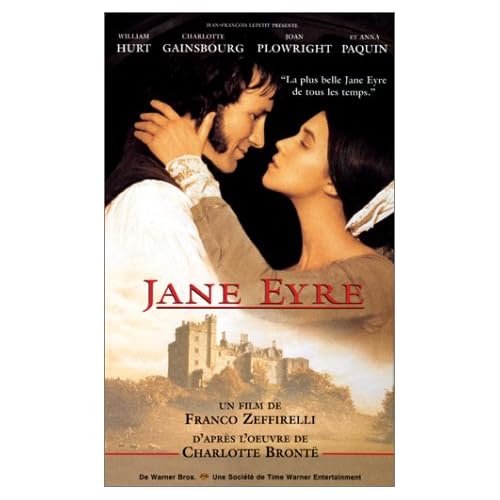
Tagline: The passionate tale of forbidden secrets!
Plot Summary:
Jane Eyre is an orphan cast out as a young girl by her aunt, Mrs. Reed, and
sent to be raised in a harsh charity school for girls...
William Hurt
Charlotte Gainsbourg
Anna Paquin
http://rapidshare.com/files/61049790/jane_eyre.part1.rar.html
http://rapidshare.com/files/61008953/jane_eyre.part2.rar.html
http://rapidshare.com/files/61008864/jane_eyre.part3.rar.html
http://rapidshare.com/files/61008898/jane_eyre.part4.rar.html
http://rapidshare.com/files/61008945/jane_eyre.part5.rar.html
http://rapidshare.com/files/61008796/jane_eyre.part6.rar.html
http://rapidshare.com/files/61008903/jane_eyre.part7.rar.html
http://rapidshare.com/files/61008896/jane_eyre.part8.rar.html
 این وبلاگ را در مهر 1385 برای کمک به دانشجویان ادبیات انگلیسی راه اندازی کردم