Mrs. Dalloway by Virginia Woolf
Mrs. Dalloway
by Virginia Woolf
Plot Overview
Mrs. Dalloway covers one day from morning to night in one woman’s life. Clarissa Dalloway, an upper-class housewife, walks through her London neighborhood to prepare for the party she will host that evening. When she returns from flower shopping, an old suitor and friend, Peter Walsh, drops by her house unexpectedly. The two have always judged each other harshly, and their meeting in the present intertwines with their thoughts of the past. Years earlier, Clarissa refused Peter’s marriage proposal, and Peter has never quite gotten over it. Peter asks Clarissa if she is happy with her husband, Richard, but before she can answer, her daughter, Elizabeth, enters the room. Peter leaves and goes to Regent’s Park. He thinks about Clarissa’s refusal, which still obsesses him.
The point of view then shifts to Septimus, a veteran of World War I who was injured in trench warfare and now suffers from shell shock. Septimus and his Italian wife, Lucrezia, pass time in Regent’s Park. They are waiting for Septimus’s appointment with Sir William Bradshaw, a celebrated psychiatrist. Before the war, Septimus was a budding young poet and lover of Shakespeare; when the war broke out, he enlisted immediately for romantic patriotic reasons. He became numb to the horrors of war and its aftermath: when his friend Evans died, he felt little sadness. Now Septimus sees nothing of worth in the England he fought for, and he has lost the desire to preserve either his society or himself. Suicidal, he believes his lack of feeling is a crime. Clearly Septimus’s experiences in the war have permanently scarred him, and he has serious mental problems. However, Sir William does not listen to what Septimus says and diagnoses “a lack of proportion.” Sir William plans to separate Septimus from Lucrezia and send him to a mental institution in the country.
Richard Dalloway eats lunch with Hugh Whitbread and Lady Bruton, members of high society. The men help Lady Bruton write a letter to the Times, London's largest newspaper. After lunch, Richard returns home to Clarissa with a large bunch of roses. He intends to tell her that he loves her but finds that he cannot, because it has been so long since he last said it. Clarissa considers the void that exists between people, even between husband and wife. Even though she values the privacy she is able to maintain in her marriage, considering it vital to the success of the relationship, at the same time she finds slightly disturbing the fact that Richard doesn’t know everything about her. Clarissa sees off Elizabeth and her history teacher, Miss Kilman, who are going shopping. The two older women despise one another passionately, each believing the other to be an oppressive force over Elizabeth. Meanwhile, Septimus and Lucrezia are in their apartment, enjoying a moment of happiness together before the men come to take Septimus to the asylum. One of Septimus’s doctors, Dr. Holmes, arrives, and Septimus fears the doctor will destroy his soul. In order to avoid this fate, he jumps from a window to his death.
Peter hears the ambulance go by to pick up Septimus’s body and marvels ironically at the level of London’s civilization. He goes to Clarissa’s party, where most of the novel’s major characters are assembled. Clarissa works hard to make her party a success but feels dissatisfied by her own role and acutely conscious of Peter’s critical eye. All the partygoers, but especially Peter and Sally Seton, have, to some degree, failed to accomplish the dreams of their youth. Though the social order is undoubtedly changing, Elizabeth and the members of her generation will probably repeat the errors of Clarissa’s generation. Sir William Bradshaw arrives late, and his wife explains that one of his patients, the young veteran (Septimus), has committed suicide. Clarissa retreats to the privacy of a small room to consider Septimus’s death. She understands that he was overwhelmed by life and that men like Sir William make life intolerable. She identifies with Septimus, admiring him for having taken the plunge and for not compromising his soul. She feels, with her comfortable position as a society hostess, responsible for his death. The party nears its close as guests begin to leave. Clarissa enters the room, and her presence fills Peter with a great excitement.
Characters
Clarissa Dalloway
Clarissa Dalloway, the heroine of the novel, struggles constantly to balance her internal life with the external world. Her world consists of glittering surfaces, such as fine fashion, parties, and high society, but as she moves through that world she probes beneath those surfaces in search of deeper meaning. Yearning for privacy, Clarissa has a tendency toward introspection that gives her a profound capacity for emotion, which many other characters lack. However, she is always concerned with appearances and keeps herself tightly composed, seldom sharing her feelings with anyone. She uses a constant stream of convivial chatter and activity to keep her soul locked safely away, which can make her seem shallow even to those who know her well.
Constantly overlaying the past and the present, Clarissa strives to reconcile herself to life despite her potent memories. For most of the novel she considers aging and death with trepidation, even as she performs life-affirming actions, such as buying flowers. Though content, Clarissa never lets go of the doubt she feels about the decisions that have shaped her life, particularly her decision to marry Richard instead of Peter Walsh. She understands that life with Peter would have been difficult, but at the same time she is uneasily aware that she sacrificed passion for the security and tranquility of an upper-class life. At times she wishes for a chance to live life over again. She experiences a moment of clarity and peace when she watches her old neighbor through her window, and by the end of the day she has come to terms with the possibility of death. Like Septimus, Clarissa feels keenly the oppressive forces in life, and she accepts that the life she has is all she’ll get. Her will to endure, however, prevails.
Septimus Warren Smith
Septimus, a veteran of World War I, suffers from shell shock and is lost within his own mind. He feels guilty even as he despises himself for being made numb by the war. His doctor has ordered Lucrezia, Septimus’s wife, to make Septimus notice things outside himself, but Septimus has removed himself from the physical world. Instead, he lives in an internal world, wherein he sees and hears things that aren’t really there and he talks to his dead friend Evans. He is sometimes overcome with the beauty in the world, but he also fears that the people in it have no capacity for honesty or kindness. Woolf intended for Clarissa to speak the sane truth and Septimus the insane truth, and indeed Septimus’s detachment enables him to judge other people more harshly than Clarissa is capable of. The world outside of Septimus is threatening, and the way Septimus sees that world offers little hope.
On the surface, Septimus seems quite dissimilar to Clarissa, but he embodies many characteristics that Clarissa shares and thinks in much the same way she does. He could almost be her double in the novel. Septimus and Clarissa both have beak-noses, love Shakespeare, and fear oppression. More important, as Clarissa’s double, Septimus offers a contrast between the conscious struggle of a working-class veteran and the blind opulence of the upper class. His troubles call into question the legitimacy of the English society he fought to preserve during the war. Because his thoughts often run parallel to Clarissa’s and echo hers in many ways, the thin line between what is considered sanity and insanity gets thinner and thinner. Septimus chooses to escape his problems by killing himself, a dramatic and tragic gesture that ultimately helps Clarissa to accept her own choices, as well as the society in which she lives.
Peter Walsh
Peter Walsh’s most consistent character trait is ambivalence: he is middle-aged and fears he has wasted his life, but sometimes he also feels he is not yet old. He cannot commit to an identity, or even to a romantic partner. He cannot decide what he feels and tries often to talk himself into feeling or not feeling certain things. For example, he spends the day telling himself that he no longer loves Clarissa, but his grief at losing her rises painfully to the surface when he is in her presence, and his obsession with her suggests that he is still attracted to her and may even long for renewed romance. Even when he gathers his anger toward Clarissa and tells her about his new love, he cannot sustain the anger and ends up weeping. Peter acts as a foil to Richard, who is stable, generous, and rather simple. Unlike calm Richard, Peter is like a storm, thundering and crashing, unpredictable even to himself.
Peter’s unhealed hurt and persistent insecurity make him severely critical of other characters, especially the Dalloways. He detests Clarissa’s bourgeois lifestyle, though he blames Richard for making her into the kind of woman she is. Clarissa intuits even his most veiled criticisms, such as when he remarks on her green dress, and his judgments strongly affect her own assessments of her life and choices. Despite his sharp critiques of others, Peter cannot clearly see his own shortcomings. His self-obsession and neediness would have suffocated Clarissa, which is partly why she refused his marriage proposal as a young woman. Peter acquiesces to the very English society he criticizes, enjoying the false sense of order it offers, which he lacks in his life. Despite Peter’s ambivalence and tendency toward analysis, he still feels life deeply. While Clarissa comes to terms with her own mortality, Peter becomes frantic at the thought of death. He follows a young woman through the London streets to smother his thoughts of death with a fantasy of life and adventure. His critical nature may distance him from others, but he values his life nonetheless.
Sally Seton
Sally Seton exists only as a figure in Clarissa’s memory for most of the novel, and when she appears at Clarissa’s party, she is older but still familiar. Though the women have not seen each other for years, Sally still puts Clarissa first when she counts her blessings, even before her husband or five sons. As a girl, Sally was without inhibitions, and as an adult at the party, she is still effusive and lacks Clarissa’s restraint. Long ago, Sally and Clarissa plotted to reform the world together. Now, however, both are married, a fate they once considered a “catastrophe.” Sally has changed and calmed down a great deal since the Bourton days, but she is still enough of a loose cannon to make Peter nervous and to kindle Clarissa’s old warm feelings. Both Sally and Clarissa have yielded to the forces of English society to some degree, but Sally keeps more distance than Clarissa does. She often takes refuge in her garden, as she despairs over communicating with humans. However, she has not lost all hope of meaningful communication, and she still thinks saying what one feels is the most important contribution one can make to society.
Clarissa considers the moment when Sally kissed her on the lips and offered her a flower at Bourton the “most exquisite moment of her whole life.” Society would never have allowed that love to flourish, since women of Clarissa’s class were expected to marry and become society wives. Sally has always been more of a free spirit than Clarissa, and when she arrives at Clarissa’s party, she feels rather distant from and confused by the life Clarissa has chosen. The women’s kiss marked a true moment of passion that could have pushed both women outside of the English society they know, and it stands out in contrast to the confrontation Peter remembers between Sally and Hugh regarding women’s rights. One morning at Bourton, Sally angrily told Hugh he represented the worst of the English middle class and that he was to blame for the plight of the young girls in Piccadilly. Later, Hugh supposedly kissed her in the smoking room. Hugh’s is the forced kiss of traditional English society, while the kiss with Clarissa is a revelation. Ultimately, the society that spurs Hugh’s kiss prevails for both women.
Richard Dalloway
Richard’s simplicity and steadfastness have enabled him to build a stable life for Clarissa, but these same qualities represent the compromise that marrying him required. Richard is a simple, hardworking, sensible husband who loves Clarissa and their daughter, Elizabeth. However, he will never share Clarissa’s desire to truly and fully communicate, and he cannot appreciate the beauty of life in the same way she can. At one point, Richard tries to overcome his habitual stiffness and shyness by planning to tell Clarissa that he loves her, but he is ultimately too repressed to say the words, in part because it has been so long since he last said them. Just as he does not understand Clarissa’s desires, he does not recognize Elizabeth’s potential as a woman. If he had had a son, he would have encouraged him to work, but he does not offer the same encouragement to Elizabeth, even as she contemplates job options. His reticence on the matter increases the likelihood that she will eventually be in the same predicament as Clarissa, unable to support herself through a career and thus unable to gain the freedom to follow her passions.
Richard considers tradition of prime importance, rather than passion or open communication. He champions the traditions England went to war to preserve, in contrast to Septimus, and does not recognize their destructive power. Despite his occasional misgivings, Richard has close associations with members of English high society. He is critical of Hugh, but they revere many of the same symbols, including the figure of the grand old lady with money, who is helpless when it comes to surviving in a patriarchal society. Richard likes the fact that women need him, but sometimes he wrongly assumes they do. For example, he does not recognize that a female vagrant may not want his help but may instead enjoy living outside the rules of his society. For Richard, this sort of freedom is unimaginable.
Themes
Communication vs. Privacy
Throughout Mrs. Dalloway, Clarissa, Septimus, Peter, and others struggle to find outlets for communication as well as adequate privacy, and the balance between the two is difficult for all to attain. Clarissa in particular struggles to open the pathway for communication and throws parties in an attempt to draw people together. At the same time, she feels shrouded within her own reflective soul and thinks the ultimate human mystery is how she can exist in one room while the old woman in the house across from hers exists in another. Even as Clarissa celebrates the old woman’s independence, she knows it comes with an inevitable loneliness. Peter tries to explain the contradictory human impulses toward privacy and communication by comparing the soul to a fish that swims along in murky water, then rises quickly to the surface to frolic on the waves. The war has changed people’s ideas of what English society should be, and understanding is difficult between those who support traditional English society and those who hope for continued change. Meaningful connections in this disjointed postwar world are not easy to make, no matter what efforts the characters put forth. Ultimately, Clarissa sees Septimus’s death as a desperate, but legitimate, act of communication.
Disillusionment with the British Empire
Throughout the nineteenth century, the British Empire seemed invincible. It expanded into many other countries, such as India, Nigeria, and South Africa, becoming the largest empire the world had ever seen. World War I was a violent reality check. For the first time in nearly a century, the English were vulnerable on their own land. The Allies technically won the war, but the extent of devastation England suffered made it a victory in name only. Entire communities of young men were injured and killed. In 1916, at the Battle of the Somme, England suffered 60,000 casualties—the largest slaughter in England’s history. Not surprisingly, English citizens lost much of their faith in the empire after the war. No longer could England claim to be invulnerable and all-powerful. Citizens were less inclined to willingly adhere to the rigid constraints imposed by England’s class system, which benefited only a small margin of society but which all classes had fought to preserve.
In 1923, when Mrs. Dalloway takes place, the old establishment and its oppressive values are nearing their end. English citizens, including Clarissa, Peter, and Septimus, feel the failure of the empire as strongly as they feel their own personal failures. Those citizens who still champion English tradition, such as Aunt Helena and Lady Bruton, are old. Aunt Helena, with her glass eye (perhaps a symbol of her inability or unwillingness to see the empire's disintegration), is turning into an artifact. Anticipating the end of the Conservative Party’s reign, Richard plans to write the history of the great British military family, the Brutons, who are already part of the past. The old empire faces an imminent demise, and the loss of the traditional and familiar social order leaves the English at loose ends.
The Fear of Death
Thoughts of death lurk constantly beneath the surface of everyday life in Mrs. Dalloway, especially for Clarissa, Septimus, and Peter, and this awareness makes even mundane events and interactions meaningful, sometimes even threatening. At the very start of her day, when she goes out to buy flowers for her party, Clarissa remembers a moment in her youth when she suspected a terrible event would occur. Big Ben tolls out the hour, and Clarissa repeats a line from Shakespeare’s Cymbeline over and over as the day goes on: “Fear no more the heat o’ the sun / Nor the furious winter’s rages.” The line is from a funeral song that celebrates death as a comfort after a difficult life. Middle-aged Clarissa has experienced the deaths of her father, mother, and sister and has lived through the calamity of war, and she has grown to believe that living even one day is dangerous. Death is very naturally in her thoughts, and the line from Cymbeline, along with Septimus’s suicidal embrace of death, ultimately helps her to be at peace with her own mortality. Peter Walsh, so insecure in his identity, grows frantic at the idea of death and follows an anonymous young woman through London to forget about it. Septimus faces death most directly. Though he fears it, he finally chooses it over what seems to him a direr alternative—living another day.
The Threat of Oppression
Oppression is a constant threat for Clarissa and Septimus in Mrs. Dalloway, and Septimus dies in order to escape what he perceives to be an oppressive social pressure to conform. It comes in many guises, including religion, science, or social convention. Miss Kilman and Sir William Bradshaw are two of the major oppressors in the novel: Miss Kilman dreams of felling Clarissa in the name of religion, and Sir William would like to subdue all those who challenge his conception of the world. Both wish to convert the world to their belief systems in order to gain power and dominate others, and their rigidity oppresses all who come into contact with them. More subtle oppressors, even those who do not intend to, do harm by supporting the repressive English social system. Though Clarissa herself lives under the weight of that system and often feels oppressed by it, her acceptance of patriarchal English society makes her, in part, responsible for Septimus’s death. Thus she too is an oppressor of sorts. At the end of the novel, she reflects on his suicide: “Somehow it was her disaster—her disgrace.” She accepts responsibility, though other characters are equally or more fully to blame, which suggests that everyone is in some way complicit in the oppression of others.
Motifs
Time
Time imparts order to the fluid thoughts, memories, and encounters that make up Mrs. Dalloway. Big Ben, a symbol of England and its might, sounds out the hour relentlessly, ensuring that the passage of time, and the awareness of eventual death, is always palpable. Clarissa, Septimus, Peter, and other characters are in the grip of time, and as they age they evaluate how they have spent their lives. Clarissa, in particular, senses the passage of time, and the appearance of Sally and Peter, friends from the past, emphasizes how much time has gone by since Clarissa was young. Once the hour chimes, however, the sound disappears—its “leaden circles dissolved in the air.” This expression recurs many times throughout the novel, indicating how ephemeral time is, despite the pomp of Big Ben and despite people’s wary obsession with it. “It is time,” Rezia says to Septimus as they sit in the park waiting for the doctor's appointment on Harley Street. The ancient woman at the Regent’s Park Tube station suggests that the human condition knows no boundaries of time, since she continues to sing the same song for what seems like eternity. She understands that life is circular, not merely linear, which is the only sort of time that Big Ben tracks. Time is so important to the themes, structure, and characters of this novel that Woolf almost named her book The Hours.
Shakespeare
The many appearances of Shakespeare specifically and poetry in general suggest hopefulness, the possibility of finding comfort in art, and the survival of the soul in Mrs. Dalloway. Clarissa quotes Shakespeare’s plays many times throughout the day. When she shops for flowers at the beginning of the novel, she reads a few lines from a Shakespeare play, Cymbeline, in a book displayed in a shop window. The lines come from a funeral hymn in the play that suggests death should be embraced as a release from the constraints of life. Since Clarissa fears death for much of the novel, these lines suggest that an alternative, hopeful way of addressing the prospect of death exists. Clarissa also identifies with the title character in Othello, who loves his wife but kills her out of jealousy, then kills himself when he learns his jealousy was unwarranted. Clarissa shares with Othello the sense of having lost a love, especially when she thinks about Sally Seton. Before the war, Septimus appreciated Shakespeare as well, going so far as aspiring to be a poet. He no longer finds comfort in poetry after he returns.
The presence of an appreciation for poetry reveals much about Clarissa and Septimus, just as the absence of such appreciation reveals much about the characters who differ from them, such as Richard Dalloway and Lady Bruton. Richard finds Shakespeare’s sonnets indecent, and he compares reading them to listening in at a keyhole. Not surprisingly, Richard himself has a difficult time voicing his emotions. Lady Bruton never reads poetry either, and her demeanor is so rigid and impersonal that she has a reputation of caring more for politics than for people. Traditional English society promotes a suppression of visible emotion, and since Shakespeare and poetry promote a discussion of feeling and emotion, they belong to sensitive people like Clarissa, who are in many ways antiestablishment.
Trees and Flowers
Tree and flower images abound in Mrs. Dalloway. The color, variety, and beauty of flowers suggest feeling and emotion, and those characters who are comfortable with flowers, such as Clarissa, have distinctly different personalities than those characters who are not, such as Richard and Lady Bruton. The first time we see Clarissa, a deep thinker, she is on her way to the flower shop, where she will revel in the flowers she sees. Richard and Hugh, more emotionally repressed representatives of the English establishment, offer traditional roses and carnations to Clarissa and Lady Bruton, respectively. Richard handles the bouquet of roses awkwardly, like a weapon. Lady Bruton accepts the flowers with a “grim smile” and lays them stiffly by her plate, also unsure of how to handle them. When she eventually stuffs them into her dress, the femininity and grace of the gesture are rare and unexpected. Trees, with their extensive root systems, suggest the vast reach of the human soul, and Clarissa and Septimus, who both struggle to protect their souls, revere them. Clarissa believes souls survive in trees after death, and Septimus, who has turned his back on patriarchal society, feels that cutting down a tree is the equivalent of committing murder.
Waves and Water
Waves and water regularly wash over events and thoughts in Mrs. Dalloway and nearly always suggest the possibility of extinction or death. While Clarissa mends her party dress, she thinks about the peaceful cycle of waves collecting and falling on a summer day, when the world itself seems to say “that is all.” Time sometimes takes on waterlike qualities for Clarissa, such as when the chime from Big Ben “flood[s]” her room, marking another passing hour. Rezia, in a rare moment of happiness with Septimus after he has helped her construct a hat, lets her words trail off “like a contented tap left running.” Even then, she knows that stream of contentedness will dry up eventually. The narrative structure of the novel itself also suggests fluidity. One character’s thoughts appear, intensify, then fade into another’s, much like waves that collect then fall.
Traditional English society itself is a kind of tide, pulling under those people not strong enough to stand on their own. Lady Bradshaw, for example, eventually succumbs to Sir William’s bullying, overbearing presence. The narrator says “she had gone under,” that her will became “water-logged” and eventually sank into his. Septimus is also sucked under society’s pressures. Earlier in the day, before he kills himself, he looks out the window and sees everything as though it is underwater. Trees drag their branches through the air as though dragging them through water, the light outside is “watery gold,” and his hand on the sofa reminds him of floating in seawater. While Septimus ultimately cannot accept or function in society, Clarissa manages to navigate it successfully. Peter sees Clarissa in a “silver-green mermaid’s dress” at her party, “[l]olloping on the waves.” Between her mermaid’s dress and her ease in bobbing through her party guests, Clarissa succeeds in staying afloat. However, she identifies with Septimus’s wish to fight the cycle and go under, even if she will not succumb to the temptation herself.
Symbols
The Prime Minister
The prime minister in Mrs. Dalloway embodies England’s old values and hierarchical social system, which are in decline. When Peter Walsh wants to insult Clarissa and suggest she will sell out and become a society hostess, he says she will marry a prime minister. When Lady Bruton, a champion of English tradition, wants to compliment Hugh, she calls him “My Prime Minister.” The prime minister is a figure from the old establishment, which Clarissa and Septimus are struggling against. Mrs. Dalloway takes place after World War I, a time when the English looked desperately for meaning in the old symbols but found the symbols hollow. When the conservative prime minister finally arrives at Clarissa’s party, his appearance is unimpressive. The old pyramidal social system that benefited the very rich before the war is now decaying, and the symbols of its greatness have become pathetic.
Peter Walsh’s Pocketknife and Other Weapons
Peter Walsh plays constantly with his pocketknife, and the opening, closing, and fiddling with the knife suggest his flightiness and inability to make decisions. He cannot decide what he feels and doesn’t know whether he abhors English tradition and wants to fight it, or whether he accepts English civilization just as it is. The pocketknife reveals Peter’s defensiveness. He is armed with the knife, in a sense, when he pays an unexpected visit to Clarissa, while she herself is armed with her sewing scissors. Their weapons make them equal competitors. Knives and weapons are also phallic symbols, hinting at sexuality and power. Peter cannot define his own identity, and his constant fidgeting with the knife suggests how uncomfortable he is with his masculinity. Characters fall into two groups: those who are armed and those who are not. Ellie Henderson, for example, is “weaponless,” because she is poor and has not been trained for any career. Her ambiguous relationship with her friend Edith also puts her at a disadvantage in society, leaving her even less able to defend herself. Septimus, psychologically crippled by the literal weapons of war, commits suicide by impaling himself on a metal fence, showing the danger lurking behind man-made boundaries.
The Old Woman in the Window
The old woman in the window across from Clarissa’s house represents the privacy of the soul and the loneliness that goes with it, both of which will increase as Clarissa grows older. Clarissa sees the future in the old woman: She herself will grow old and become more and more alone, since that is the nature of life. As Clarissa grows older, she reflects more but communicates less. Instead, she keeps her feelings locked inside the private rooms of her own soul, just as the old woman rattles alone around the rooms of her house. Nevertheless, the old woman also represents serenity and the purity of the soul. Clarissa respects the woman’s private reflections and thinks beauty lies in this act of preserving one’s interior life and independence. Before Septimus jumps out the window, he sees an old man descending the staircase outside, and this old man is a parallel figure to the old woman. Though Clarissa and Septimus ultimately choose to preserve their private lives in opposite ways, their view of loneliness, privacy, and communication resonates within these similar images.
The Old Woman Singing an Ancient Song
Opposite the Regent’s Park Tube station, an old woman sings an ancient song that celebrates life, endurance, and continuity. She is oblivious to everyone around her as she sings, beyond caring what the world thinks. The narrator explains that no matter what happens in the world, the old woman will still be there, even in “ten million years,” and that the song has soaked “through the knotted roots of infinite ages.” Roots, intertwined and hidden beneath the earth, suggest the deepest parts of people’s souls, and this woman’s song touches everyone who hears it in some way. Peter hears the song first and compares the old woman to a rusty pump. He doesn’t catch her triumphant message and feels only pity for her, giving her a coin before stepping into a taxi. Rezia, however, finds strength in the old woman’s words, and the song makes her feel as though all will be okay in her life. Women in the novel, who have to view patriarchal English society from the outside, are generally more attuned to nature and the messages of voices outside the mainstream. Rezia, therefore, is able to see the old woman for the life force she is, instead of simply a nuisance or a tragic figure to be dealt with, ignored, or pitied.
source: spark notes
Mrs Dalloway (1997) - Marleen Gorris
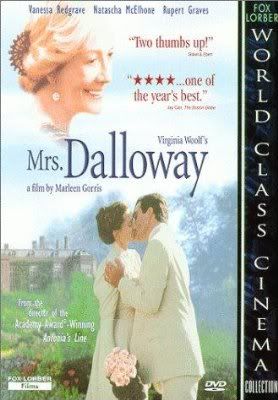
Runtime: 97
Language: English
Country: UK | USA | Netherlands
Director: Marleen Gorris
Cast:
Vanessa Redgrave ... Mrs. Clarissa Dalloway
Natascha McElhone ... Young Clarissa
Michael Kitchen ... Peter Walsh
Alan Cox ... Young Peter
Sarah Badel ... Lady Rosseter
Lena Headey ... Young Sally
John Standing ... Richard Dalloway
Robert Portal ... Young Richard
Oliver Ford Davies ... Hugh Whitbread
Hal Cruttenden ... Young Hugh
Rupert Graves ... Septimus Warren Smith
Amelia Bullmore ... Rezia Warren Smith
Margaret Tyzack ... Lady Bruton
Description: Clarissa Dalloway sets out on a beautiful morning; she's shopping for flowers for her party that evening. At the same time in London, a young man is suffering from a nightmarish delayed-onset (the year is 1923) form of shell-shock. Clarissa's nearly-grown daughter is distant, and preoccupied. In the course of one day, Peter, a passionate old suitor, returns from India, there is a suicide, Clarissa relives a day in her youth (and her reasons for her choice of a life with the reliable Richard Dalloway).
http://rapidshare.com/files/219949091/MrsDlw.part1.rar
http://rapidshare.com/files/219949095/MrsDlw.part2.rar
http://rapidshare.com/files/220065785/MrsDlw.part3.rar
http://rapidshare.com/files/220065794/MrsDlw.part4.rar
http://rapidshare.com/files/220172031/MrsDlw.part5.rar
http://rapidshare.com/files/220172032/MrsDlw.part6.rar
http://rapidshare.com/files/220250454/MrsDlw.part7.rar
http://rapidshare.com/files/220250457/MrsDlw.part8.rar
 این وبلاگ را در مهر 1385 برای کمک به دانشجویان ادبیات انگلیسی راه اندازی کردم